

The re-election of Donald Trump, has provoked an outcry among globalists and the European Union’s political elite. The reactions on X from figures like Liberal Democrat Leader Edward Davey, Philosopher A. C. Grayling, and EU Federalist Guy Verhofstadt reveal more than just political disagreement; they showcase a profound inability to grapple with democratic outcomes that defy their own narrow visions of how the world should work.
Edward Davey’s Theatrical Despair
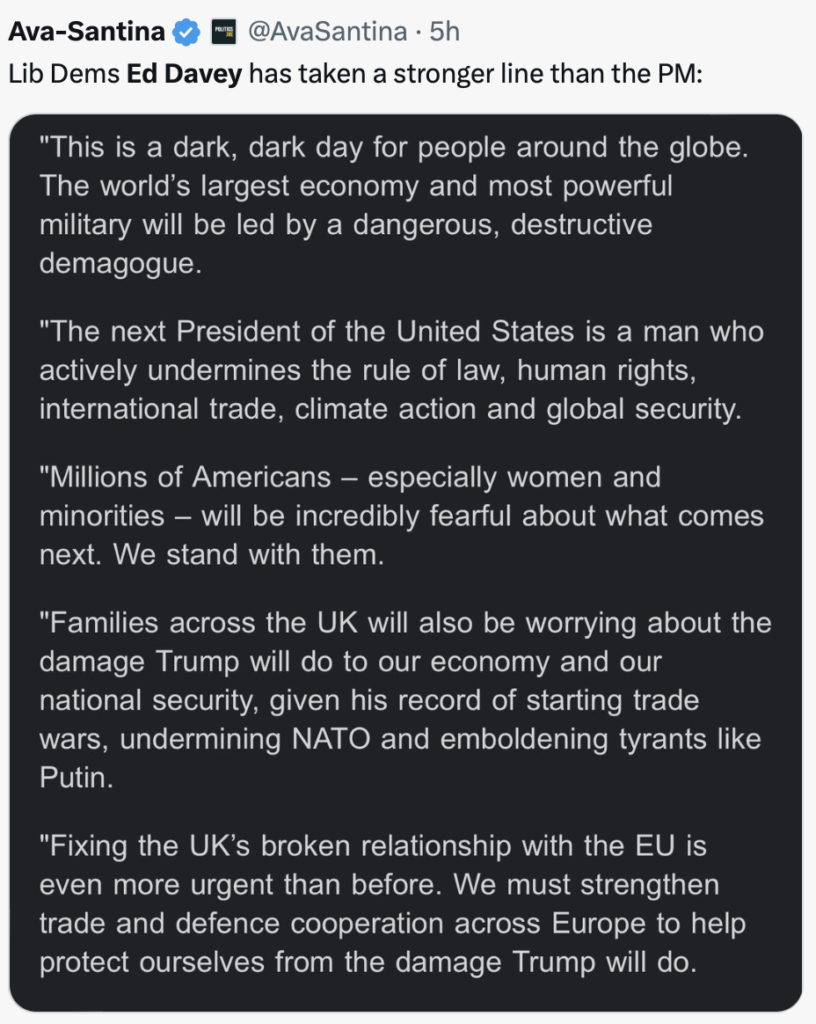
Edward Davey’s tweet, proclaiming the day of Trump’s victory as a “dark, dark day for people around the globe,” is an absurdly melodramatic leap into despair. Davey, who seems to view the world through a lens where only his political ideals hold moral clarity, paints Trump as a “dangerous, destructive demagogue.” This hyperbolic rhetoric is indicative of his tendency to engage in fear-mongering rather than fostering a dialogue to address the nuances of international politics. His dramatic flair might be mistaken for depth, but it often lacks the substantive engagement required for serious political discourse.
A. C. Grayling’s Intellectual Disconnect
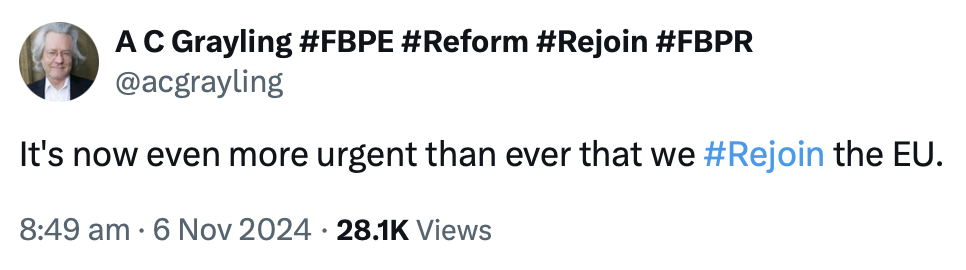
Philosopher A. C. Grayling tweeted about Trump’s re-election being an “ominous sign for democracy globally,” critiquing Trump’s disregard for truth and international norms. Yet, Grayling’s critique might be seen as an exercise in intellectual elitism, where he posits his interpretation of democracy as the only valid one.
His words suggest a failure to acknowledge that democracy, by its nature, includes outcomes where voters choose leaders like Trump, not because they are unaware of his flaws but perhaps in spite of them. Grayling’s tendency to equate his political preferences with the health of democracy demonstrates that he lacks the humility to accept that democracy thrives on diversity of thought, even if it includes views he finds distasteful.
Guy Verhofstadt’s Policy Panic
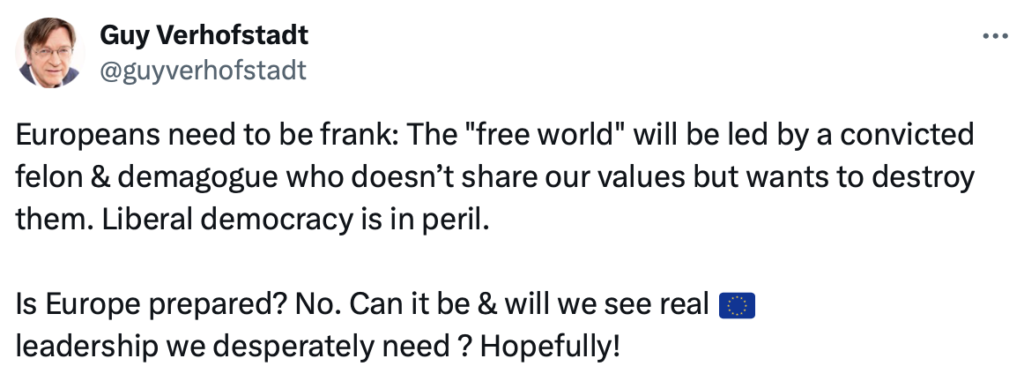
Guy Verhofstadt lamented Trump’s win as a setback for globalism, warning of risks to trade deals and environmental agreements. Verhofstadt’s reaction betrays a typical fear among EU federalists that any deviation from global integration is catastrophic. His call for the EU to take destiny into its own hands post-Trump seems out of touch with economic realities where the EU depends heavily on transatlantic relations.
His critique entirely overlooks the legitimate frustrations of those who feel globalism has left them behind or does not serve their interests, reducing complex geopolitical shifts to a narrative of ‘us versus them’. Verhofstadt’s alarmism might serve more to rally his base than to provide a balanced view of the implications of Trump’s policies.
Insight into the Meltdown
The reactions from these EU fanatics expose a critical flaw in their political engagement: an inability to critically assess their own biases or to engage with political outcomes that don’t align with their worldview. Their mindset leads them to equate differing political outcomes with the erosion of civilization itself.
Their tweets serve as a reminder that in politics, as in life, one must sometimes accept the diversity of democratic decisions, even when it leads to outcomes one vehemently opposes.
Perhaps, most ironically, it is that those, such as Verhofstadt, who claim that democracy is in peril, who refuse to accept democratic outcomes with good grace. Surely such people, who put themselves up to be elected as representatives of the people, should embrace the decisions made by the people? That’s democracy.