
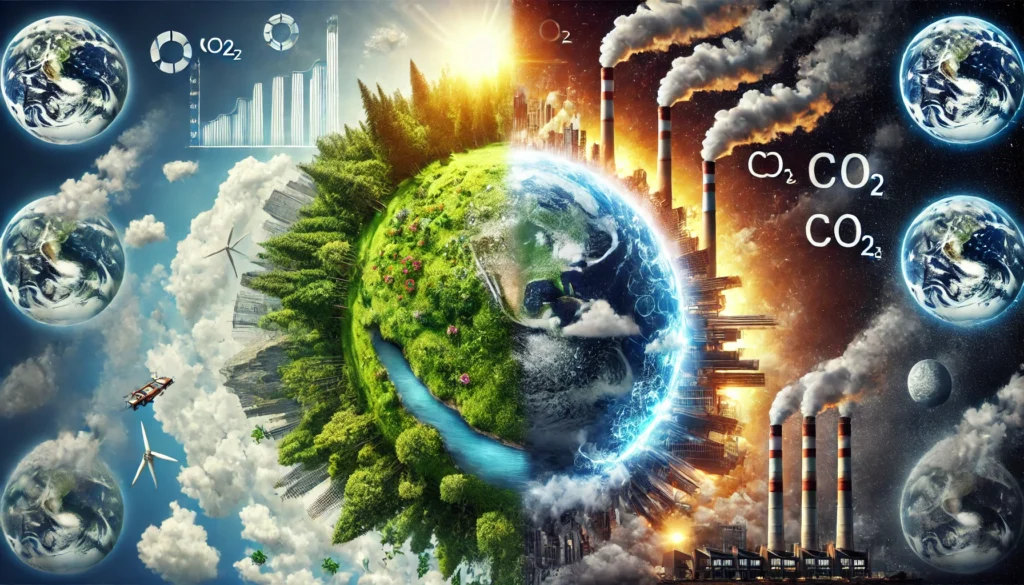
For decades, the dominant narrative has been clear: carbon dioxide (CO2) is the primary driver of climate change. Policymakers, scientists, and activists worldwide have rallied around this greenhouse gas, claiming it is responsible for rising global temperatures. However, this consensus deserves closer scrutiny. Is the science truly settled, or have alternative explanations been prematurely dismissed?
CO2: A Trace Gas with a Big Reputation
CO2 constitutes a mere 0.04% of the Earth’s atmosphere. While it is true that this trace gas plays a role in trapping heat, its impact may be overstated. Historically, CO2 levels have risen after periods of warming rather than preceding them, as ice core data from Antarctica suggests. This raises an important question: if CO2 increases are a result, rather than a cause, of warming, should it remain the main focus of climate policy?
Moreover, water vapour accounts for the majority of the greenhouse effect—up to 95%, by some estimates. Why, then, does CO2 dominate the discussion? Could it be that its anthropogenic origins make it a convenient target, rather than the primary culprit?
The Role of Natural Factors
The Earth’s climate is shaped by a multitude of factors, many of which are natural and cyclical. Solar activity, oceanic oscillations (such as El Niño and La Niña), and volcanic activity have all influenced the planet’s climate over millennia. The Sun, as the Earth’s primary energy source, plays a particularly critical role. Variations in solar radiation, including sunspot activity, align closely with historical climate changes, such as the Medieval Warm Period and the Little Ice Age.
Furthermore, recent studies suggest that cosmic rays—particles from space that influence cloud formation—could have a significant impact on the Earth’s temperature. These alternative mechanisms challenge the notion that CO2 is the sole driver of climate change.
Climate Models: Predictive or Presumptive?
Much of the evidence supporting CO2’s role in climate change comes from predictive models. Yet, these models are far from perfect. Many have consistently overestimated warming trends, failing to account for periods of stable or even declining temperatures, such as the so-called “pause” observed from 1998 to 2012. If models cannot reliably predict short-term trends, how can we place unwavering confidence in their long-term forecasts?
Additionally, climate models often simplify complex systems, making assumptions about feedback mechanisms like cloud cover and ocean currents. These simplifications may amplify the role of CO2 while underestimating other factors, leading to a skewed understanding of climate dynamics.
The Economic and Political Agenda
It is impossible to ignore the political and economic dimensions of the climate change debate. CO2 has become a scapegoat for a wide range of environmental and economic policies, from carbon taxes to renewable energy subsidies. These policies often disproportionately impact developing nations and low-income populations while benefiting industries poised to profit from the green economy.
Could it be that the fixation on CO2 is less about saving the planet and more about advancing particular political or economic agendas? After all, framing CO2 as the villain simplifies the narrative, creating a clear enemy that can be taxed, regulated, and marketed against.
Conclusion: Time for a Broader Debate
None of this is to suggest that human activities have no impact on the environment or that climate change is a myth. The climate is undoubtedly changing, and humans may play a role. However, the singular focus on CO2 as the driving force is both scientifically questionable and politically convenient. By narrowing the debate, we risk overlooking alternative explanations and solutions.
Surely it is time to move beyond the oversimplified narrative and embrace a broader, more sceptical approach to understanding climate change. The stakes are too high to settle for anything less than the full truth.